
Wordle and Quordle use the same colored clues, but they reward different styles of thinking.
Wordle asks you to identify one five-letter answer in six guesses. Quordle asks you to identify four answers with nine shared guesses. The extra boards do not merely make the puzzle four times larger. They change what makes a guess valuable.
In Wordle, a move can be judged by how well it advances one board. In Quordle, every move spends a shared resource. A word that nearly solves Board 1 may reveal nothing useful on Boards 2, 3, and 4. The strongest move often balances immediate progress with information across several parallel search spaces.
Understanding that shift is the key to playing Quordle well.
Wordle strategy: optimize one board
A normal Wordle strategy has one center of attention. Every clue contributes to the same answer, so the player can maintain one evolving picture of the word.
Begin with broad letter coverage
A strong opener usually combines common vowels and consonants without repeating letters. Words such as CRANE, SLATE, and TRACE test five productive letters at once.
Vowels reveal the likely sound structure. Common consonants such as R, S, T, L, and N help separate large word families. An opener does not have to be a likely answer; its first job is to collect information.
Respect positions, not just letters
A yellow tile proves that a letter is present and that its tested position is wrong. A green tile fixes both the letter and its position. Good follow-up guesses preserve the greens, move the yellows, and use open positions to test new letters.
This turns the board into a positional constraint problem. A pattern such as S _ A _ E is much easier to reason about than an unordered collection of known letters.
Eliminate efficiently
Gray letters are usually removed from consideration. When the first guess reveals little, a second coverage word can test four or five new letters rather than reusing failed ones.
Later, the goal changes. Once the candidate list is small, a plausible answer may be better than another broad probe. Wordle strategy is partly about recognizing when to switch from gathering information to attempting the solution.
Treat duplicate letters as counts
Repeated letters complicate the colors. If a guess contains two Es but the answer contains one, one E may be green or yellow while the other is gray. The gray copy does not mean that E is absent; it establishes a maximum count.
Strong Wordle play therefore tracks how many copies of a letter are possible, not merely whether the letter appears.
Use entropy on one board
Entropy estimates how much information a guess is expected to reveal. For each possible answer, imagine the gray, yellow, and green pattern that a proposed guess would produce. A high-entropy guess divides the candidate answers into many relatively balanced groups.
On one board, the objective is straightforward: choose a word that efficiently separates the remaining answers while preserving enough turns to solve.
For a deeper single-board guide, see How to Win at Wordle: Tips, Tricks & Strategy.
Quordle strategy: manage four constraint systems
Quordle keeps the same clue rules but runs four independent boards at once. A shared guess produces four different feedback patterns, and those patterns may point in completely different directions.
This creates four candidate sets:
Board 1 → possible answers A
Board 2 → possible answers B
Board 3 → possible answers C
Board 4 → possible answers D
The boards do not share an answer, but they do share every guess. That is what makes Quordle a resource-allocation problem rather than four separate Wordle games.
Shared guesses should work on more than one board
Suppose Board 1 appears to be _IGHT, while the other boards still have dozens of candidates. Guessing LIGHT may solve Board 1 immediately, but four of its letters could repeat information already known elsewhere.
Sometimes that is the correct move—especially when a board has only one viable answer or is in danger of being stranded. But an information-rich word that distinguishes candidates on three boards may be more valuable overall, even if it cannot solve Board 1.
The key question changes from:
What is the best guess for this board?
to:
What is the best use of this shared turn?
That does not mean every guess must help all four boards equally. It means the value of a guess should be evaluated across every unsolved board.
Balance information gain across boards
A word can have high information value on one board and almost none on another.
Imagine these remaining candidate counts:
- Board 1: 3 words
- Board 2: 28 words
- Board 3: 2 words
- Board 4: 74 words
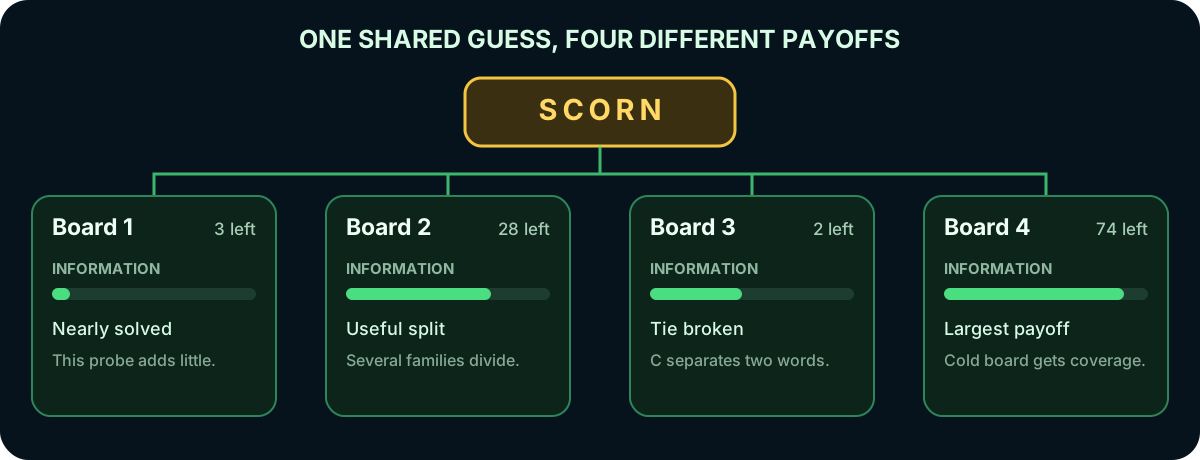
One word spends the turn everywhere, but its value can differ sharply from board to board.
A guess designed only for Board 4 might ignore a dangerous ambiguity on Board 1. A guess designed only to choose between the two words on Board 3 might waste the chance to cut the larger lists.
The best shared word often tests distinctions that occur on multiple boards. A single letter might separate two candidates on Board 3 while also splitting large word families on Boards 2 and 4.
This is the central Quordle skill: look for overlap between the unresolved decisions.
“Hot” and “cold” boards need different treatment
Players often describe a nearly solved board as hot and a broad, uncertain board as cold. Candidate count is useful, but the strategic rule is more nuanced than “always solve the smallest list first.”
A hot board deserves immediate attention when:
- only one answer remains;
- its candidates differ by letters that can also help another board;
- delaying it could create a risky word-family trap; or
- the game is approaching its final shared turns.
A hot board can safely wait when its answer is effectively forced and a broader probe will make large gains elsewhere. Replaying several confirmed letters merely to finish an obvious board can reduce the information collected by that turn.
Cold boards benefit from coverage. Early shared guesses should expose common letters and positions across their large candidate sets. The goal is to keep any one board from remaining completely unresolved while the others consume the available turns.
The practical approach is:
- Secure forced answers when the cost is low.
- Use shared probes that resolve distinctions on two or more boards.
- Watch for small but dangerous word families.
- Prevent the coldest board from becoming a last-turn guessing exercise.
A micro-case study: solve one board or help three?
Consider an illustrative mid-game position. The candidate words are simplified to make the decision visible:
| Board | Current pattern or candidates | Candidates left |
|---|---|---|
| 1 | LIGHT, MIGHT, NIGHT |
3 |
| 2 | Mixed candidates containing C, R, or S |
28 |
| 3 | CIVIC, CYNIC |
2 |
| 4 | Broad list with several untested consonants | 74 |
Two moves look attractive:
LIGHThas a one-in-three chance of finishing Board 1. It separates that board’s first-letter family poorly if the answer is notLIGHT, and several of its letters may repeat information already known elsewhere.SCORNcannot solve Board 1, butCdistinguishes Board 3’s two candidates whileS,C,O,R, andNdivide useful families on Boards 2 and 4.
Suppose the estimated information values look like this:
| Guess | Board 1 | Board 2 | Board 3 | Board 4 | Shared total |
|---|---|---|---|---|---|
LIGHT |
0.92 | 0.61 | 0.00 | 0.74 | 2.27 bits |
SCORN |
0.00 | 2.86 | 1.00 | 3.12 | 6.98 bits |
These figures are illustrative, not output from a particular daily puzzle. They demonstrate the decision: LIGHT pursues an immediate result on one board, while SCORN reduces uncertainty on three boards with the same shared turn.
If only two turns remained, finishing Board 1 might be urgent. With ample turns available, the broader probe is usually the more informative move. Quordle strategy always depends on both candidate structure and the remaining guess budget.
When to switch from probing to solving
Quordle does not have one universal moment when information gathering should stop. Each board can be in a different phase.
Continue probing when:
- several boards still have large candidate sets;
- one word can test useful distinctions on two or more boards;
- a small candidate family is safe to postpone; and
- enough shared turns remain to convert the new information into answers.
Start solving more directly when:
- a board has one forced candidate;
- the remaining boards no longer share useful probe letters;
- a dangerous family could require several one-at-a-time attempts; or
- the number of unsolved boards is approaching the number of remaining turns.
A useful endgame check is to count the unfinished boards before every move. With three boards and three turns left, there is no room for a pure information probe unless it is also a plausible solution. Earlier in the game, the same probe may be the best investment available.
Duplicate-letter logic multiplies across four boards
In Wordle, you track one set of letter counts. In Quordle, the same guessed letter can imply a different count on every board.
After one shared guess, the evidence might mean:
- Board 1 contains exactly one
E. - Board 2 contains no
E. - Board 3 contains at least two
Es. - Board 4 contains an
E, but not in either tested position.
Nothing about those statements conflicts. Each board has its own answer and its own constraints.
Humans are reasonably good at seeing a green pattern. We are much less reliable at remembering four sets of minimum counts, maximum counts, excluded positions, and repeated-letter exceptions over several guesses. This is one reason Quordle often feels manageable for the first two turns and mentally expensive by the fourth.
Why Quordle needs a different mental model
The contrast can be summarized like this:
| Wordle | Quordle |
|---|---|
| One evolving answer | Four independent answers |
| One candidate set | Four candidate sets |
| One-board optimization | Global shared-turn optimization |
| Deduction is the main challenge | Deduction plus resource allocation |
| A probe is judged on one result | A probe produces four results |
| Letter counts are tracked once | Letter counts are tracked per board |
Wordle is primarily local optimization: reduce uncertainty on the one board in front of you.
Quordle is global optimization: decide how a shared action should distribute information across four boards. Solving an individual board still requires deduction, but choosing the next shared guess is a scheduling decision as well.
How shared entropy handles the tradeoff
Entropy provides a consistent way to compare guesses across candidate lists.
For one board, the solver groups possible answers by the feedback pattern a proposed guess would produce. If the guess splits the candidates into balanced groups, its expected information gain is high. If nearly every answer produces the same pattern, the guess adds little information.
For Quordle, calculate that entropy separately on every unsolved board:
H₁ = expected information on Board 1
H₂ = expected information on Board 2
H₃ = expected information on Board 3
H₄ = expected information on Board 4
Then combine the values:
shared entropy = H₁ + H₂ + H₃ + H₄
The highest combined value identifies the guess expected to reduce the most total uncertainty. Completed boards are excluded, so the recommendation automatically shifts as the game progresses.
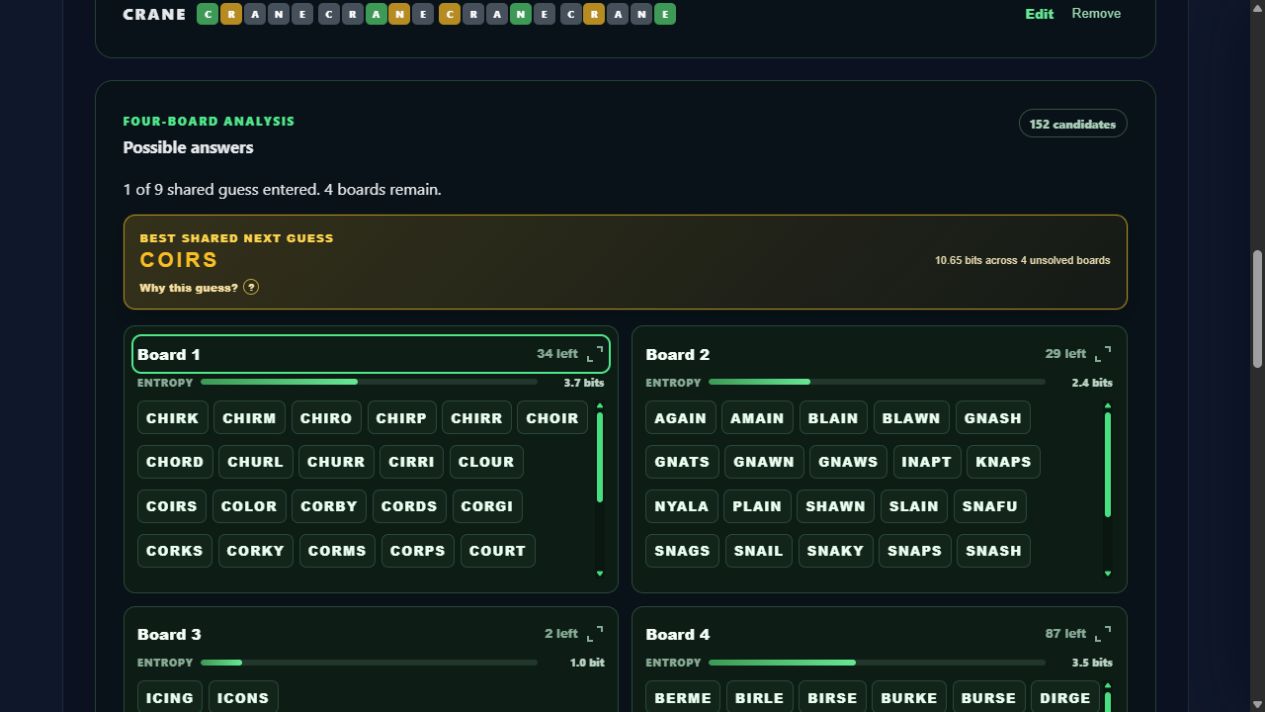
Per-board bars reveal where the shared recommendation earns its information value.
Entropy does not promise that the highest-ranked word will solve a board immediately. It measures expected reduction, not luck. Its advantage is that it evaluates the same tradeoff humans find difficult: how much one word helps four different searches.
Why human strategy becomes difficult after several guesses
After three or four shared guesses, a player may need to remember:
- four candidate lists;
- every excluded position for each yellow letter;
- fixed green positions;
- absent letters that differ between boards;
- minimum and maximum duplicate-letter counts;
- which board is forced, risky, or still broad; and
- whether a proposed word is informative across the remaining boards.
The problem is not vocabulary alone. It is working memory.
Why Quordle feels harder than it is
Each individual board still follows familiar Wordle rules. The extra difficulty comes from switching attention among four independent states while every action affects all of them. Psychologists call this kind of demand cognitive load: the task requires more information to be held and updated at once. Forgetting whether a yellow
Rbelonged to Board 2 or Board 4 is not a vocabulary failure; it is a bookkeeping failure. Externalizing the colors, candidate lists, and counts makes the underlying deductions feel much more manageable.
A player can usually reason through one board by inspecting its pattern. Doing the same for four boards—and then comparing the information value of possible shared guesses—is precisely where intuition becomes inconsistent.
Common Quordle strategy mistakes
Finishing a hot board too early
An obvious answer is satisfying, but replaying four confirmed letters can spend a shared turn that might have cut several other candidate lists. Finish it when the answer is forced and the guess also contributes elsewhere—or when the remaining-turn budget demands it.
Leaving the coldest board until the end
A board with dozens of candidates needs exposure to varied letters. If every move is chosen for nearly solved boards, the cold board may still require multiple deductions when only one turn remains.
Mixing duplicate-letter evidence between boards
A gray letter on Board 2 says nothing about its presence on Board 3. Track counts and positions separately, even though the original guess was shared.
Choosing a one-board specialist
A word can be perfect for one candidate family and redundant everywhere else. Before committing, scan all unfinished boards for letters or positions the same guess could test.
How the MonkeyTactics Quordle Solver helps
The MonkeyTactics Quordle Solver maintains the bookkeeping while leaving the decisions visible.
Enter one completed word, set the five colors for each board, and add the shared guess. The solver then:
- filters a separate candidate list for every board;
- applies duplicate-letter rules independently;
- shows candidate counts and per-board entropy bars;
- recommends a shared next guess by combined information gain;
- explains the recommendation with a “Why this guess?” tooltip;
- removes completed boards from later rankings; and
- lets you expand one board when you need a focused candidate view.
The selected board also mirrors its gray, yellow, and green states on the keyboard and stays highlighted in shared-guess history. Candidate filtering and analysis run locally in the browser.
Try shared four-board analysis in the Quordle Solver →
If you are solving only one board, the Wordle Solver & Helper provides the simpler single-board workflow.
The practical takeaway
A strong Wordle player asks, “What does this board need?”
A strong Quordle player adds a second question: “What do all of the unfinished boards need from the same turn?”
Start with broad coverage. Track every board independently. Finish forced answers when it is strategically safe, but avoid spending shared turns on information you already know. Look for guesses that resolve multiple uncertainties at once, and use per-board candidate counts to identify both quick wins and developing risks.
Wordle rewards disciplined deduction. Quordle rewards the same deduction plus careful allocation of a scarce shared resource. That is why familiar tactics still matter—and why they are no longer enough on their own.
Wordle is a trademark of The New York Times Company. Quordle is a trademark of Merriam-Webster, Incorporated. MonkeyTactics is an independent utility and is not affiliated with or endorsed by either company.