
Scrabble and Words With Friends look like close relatives. Both give you seven tiles, ask you to build connected words on a 15-by-15 grid, and reward clever use of letter and word multipliers. That similarity makes one mistake especially easy: using the same scoring instincts, word list, and solver for both games.
| Quick comparison | Scrabble | Words With Friends |
|---|---|---|
| Tiles | 100 | 104 |
| Seven-tile bonus | 50 points | 35 points |
| Letter values | Classic Scrabble table | WWF-specific table |
| Premium squares | Scrabble layout | Different, denser-feeling scoring lanes |
| Best tool | Scrabble Word Finder | Words With Friends Solver |
Compare your rack now: try the Scrabble Word Finder or the Words With Friends Solver to see how game-specific tile values change the ranking.
The strongest move can change when you switch games. A word may have a different base score. A premium square may sit in a different place. A seven-tile play earns a different bonus. Even a word accepted in one game may be rejected in the other.
That is also why MonkeyTactics has two separate tools. The Word Unscrambler and Scrabble Word Finder uses Scrabble tile values and marks a seven-letter result as a Bingo +50 candidate. The Words With Friends Solver uses Words With Friends tile values and marks the same kind of result as a Bingo +35 candidate.
Neither tool sees the live board or guarantees that a result belongs to the official word list in your particular game. Each one narrows the possibilities; you still choose the legal placement and the strategically best move.
The rules behind the quick comparison
| Difference | Scrabble | Words With Friends | Strategic effect |
|---|---|---|---|
| Rack size | 7 tiles | 7 tiles | Rack balance and leave quality matter in both. |
| Standard English tile pool | 100 tiles | 104 tiles | Tile tracking and draw expectations are not interchangeable. |
| Seven-tile bonus | 50 points | 35 points | Scrabble gives you more reason to sacrifice points now to preserve a bingo-friendly leave. |
| Tile values | Classic Scrabble values | A different value table | The same word can rank differently in the two solvers. |
| Premium layout | Scrabble arrangement | Different arrangement with more premium-square traffic | WWF more often rewards premium access and compact parallel plays. |
| Word authority | Depends on edition, region, club, or tournament list | Controlled by the app and can vary by mode or language | A dictionary word is not automatically playable in either game. |
| Typical format | Physical, club, tournament, and digital play | Primarily asynchronous digital play | WWF gives you more time to compare lanes, threats, and replies. |
Hasbro lists 100 tiles for classic Scrabble, while its Words With Friends tabletop distribution totals 104. Hasbro’s Scrabble rules award 50 points for using all seven rack tiles; Zynga’s Words With Friends rules award 35. Hasbro Scrabble instructions, Hasbro Words With Friends tile distribution, and Zynga Words With Friends scoring.
The same letters do not have the same value
Several common letters are worth more in Words With Friends than in Scrabble. That changes both the apparent value of a rack and the order in which candidate words should be considered.
| Letter | Scrabble | Words With Friends |
|---|---|---|
| B | 3 | 4 |
| C | 3 | 4 |
| G | 2 | 3 |
| H | 4 | 3 |
| J | 8 | 10 |
| L | 1 | 2 |
| M | 3 | 4 |
| N | 1 | 2 |
| U | 1 | 2 |
| V | 4 | 5 |
| Y | 4 | 3 |
The tables agree on some headline tiles—Q and Z are worth 10, while X is worth 8—but enough values differ to break a generic “highest-scoring word” calculation.
Consider JAMB. Its base value is 14 in Scrabble: J 8, A 1, M 3, and B 3. In Words With Friends it is worth 19: J 10, A 1, M 4, and B 4. Before any board multiplier, the WWF version is already five points richer.
This is the most concrete difference between the two MonkeyTactics tools. Search the same rack in both and the candidate words may be identical, because you chose the same source dictionary, but their scores and score-first ranking can differ. Use the game-specific solver before comparing moves.
A best move that flips between games
Suppose your rack is ABHMUY? and the board gives you an otherwise equivalent three-square opening represented by ???. Two legal candidates from the same letters are HAY and BUM. Assume neither play reaches a premium square or creates a cross-word, so only base tile values decide the comparison.
| Candidate | Scrabble base score | WWF base score |
|---|---|---|
HAY |
9 (H 4 + A 1 + Y 4) |
7 (H 3 + A 1 + Y 3) |
BUM |
7 (B 3 + U 1 + M 3) |
10 (B 4 + U 2 + M 4) |
On base score, Scrabble prefers HAY, while Words With Friends prefers BUM. The pattern and rack did not change; only the scoring system did. On a real board, multipliers, cross-words, leave quality, and the opponent’s reply could overturn both choices, but this controlled example shows why the correct solver matters.
Board geometry changes the best move
Both boards use double-letter, triple-letter, double-word, and triple-word squares. The multipliers work in the familiar way, but their locations are different.
Scrabble’s premium pattern encourages careful control of the star-to-corner lanes and makes opening a triple-word line a major defensive decision. Words With Friends distributes its premiums differently, including tempting letter and word multipliers near the board’s edges. The result is a game in which short words, parallel plays, and high-value letters placed on a DL or TL square frequently compete with longer words.
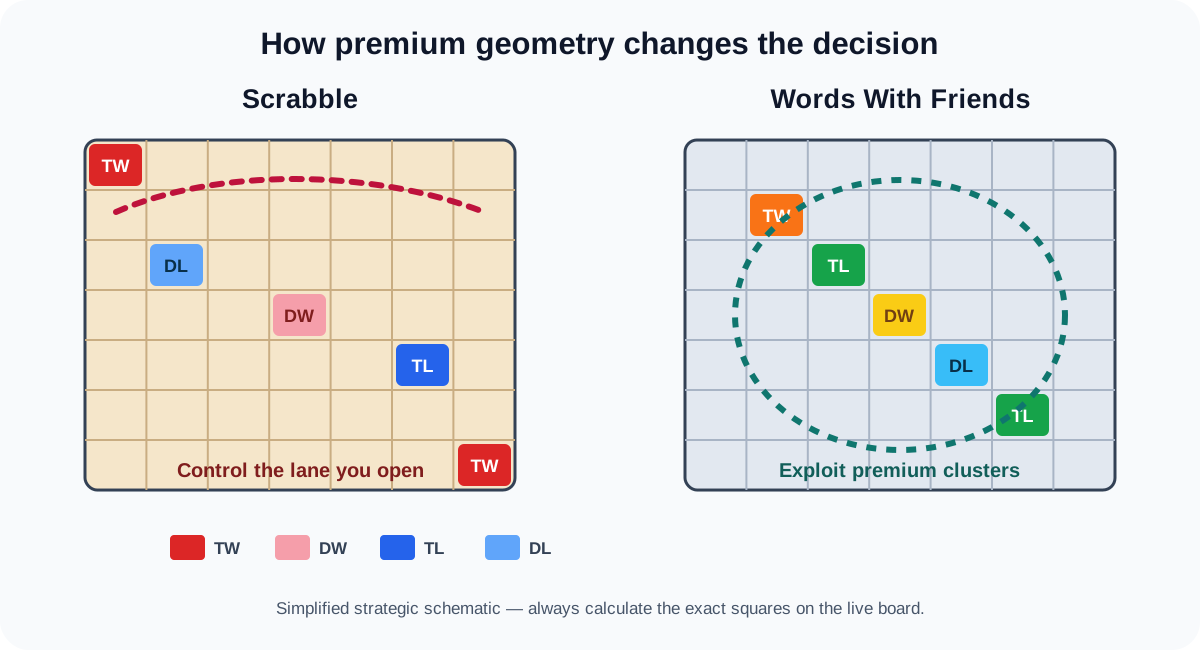
This is a strategic schematic, not a square-for-square replacement for either board. It highlights the practical difference: Scrabble often makes the lane you open the central risk, while WWF frequently creates clusters where letter and word premiums can influence the same area.
That changes the question you ask on every turn:
- In Scrabble, ask whether the move opens a dangerous double- or triple-word lane and whether the leave justifies that risk.
- In Words With Friends, inspect every compact lane that lets one tile score in multiple crossing words, especially when that tile can reach a letter multiplier.
- In both games, remember that a premium counts only when a newly placed tile covers it. A result’s base score is never the full board score.
The official Words With Friends site emphasizes connecting new words while maximizing TW and TL squares, and Zynga’s rules confirm that all words formed in a play are scored. Words With Friends Classic overview and Zynga rule book.
Bingo strategy: 50 points changes the math
Playing all seven rack tiles is powerful in both games, but Scrabble’s 50-point bonus is 15 points larger than Words With Friends’ 35-point bonus.
For a deeper treatment of stems, leaves, vowel-consonant balance, and when to exchange, read Scrabble Rack Strategy: Balance, Leaves, and More Bingos.
That gap affects leave decisions. Suppose one move scores 28 but destroys a flexible AEINST core, while another scores 21 and preserves it. In Scrabble, giving up seven points to keep a strong bingo stem may be easier to justify because the future payoff includes 50 bonus points. In Words With Friends, the same leave still has value, but the smaller bonus makes immediate premium-square scoring relatively more competitive.
This does not mean “always chase bingos in Scrabble” or “ignore bingos in WWF.” It means the break-even point changes. Compare:
- points scored now;
- quality of the remaining tiles;
- probability that the board stays open enough to use the leave; and
- risk created by the lane you open.
If you are ahead on a tight board, closing access may be worth more than preserving a beautiful stem. If you are behind, opening the board and keeping a bingo-friendly leave may be the only route to a comeback.
Dictionary differences are gameplay differences
Scrabble does not have one universal word list. North American competitive play, international play, household editions, and apps can use different lexicons. Words With Friends validates plays against its own app dictionary, and the accepted vocabulary can vary by language or game implementation.
The MonkeyTactics tools provide:
- Standard (ENABLE), a focused public-domain list with 172,820 entries;
- Expanded, with 854,775 Wiktionary-derived entries; and
- Both, with 867,177 unique entries after overlap is removed.
These independent lists are useful for study, but neither solver is an official Scrabble or Words With Friends dictionary. Before relying on an unfamiliar word, verify it in the game or authority you are actually using.
This matters strategically because hooks and short words are lexicon-dependent. If a two-letter escape or an S hook exists in one list but not another, the board can be safer—or more dangerous—than it first appears.
Strategy differences that matter most
1. Value premium access differently
In Scrabble, a modest move that keeps a strong leave can outperform a larger play because the next bingo is worth an extra 50. In WWF, a short play that lands J, V, or another boosted-value letter on a premium may deserve more weight.
Do not compare word length. Compare the complete turn: all words formed, all active multipliers, and the resulting leave.
2. Relearn your high-value letters
Scrabble players instinctively see H and Y as four-point tiles. Both are worth only three in Words With Friends. Conversely, WWF raises J to 10, V to 5, and several ordinary consonants to two, three, or four points.
That changes premium-square targeting. A J on a triple-letter square begins at 30 points in WWF and 24 in Scrabble. A familiar Scrabble ranking can therefore hide the best WWF play.
For more examples of how premium letters and board access produce outsized turns, see The Most Valuable Scrabble Words of 2026.
3. Track the correct bag
Tile tracking depends on distribution as well as value. Scrabble’s 100-tile pool and Words With Friends’ 104-tile pool produce different expectations about what remains unseen. Do not bring a memorized Scrabble bag count into a WWF endgame.
In either game, tracking becomes more valuable as the bag empties. It tells you whether keeping a U for the unseen Q is sensible, whether an S is likely to remain, and what awkward tiles you might stick your opponent with.
The full method is covered in The Science of Tile Tracking: How Experts Predict Your Opponent’s Next Move.
4. Treat asynchronous play as analysis time
Classic Scrabble is often played face to face or on a clock. Words With Friends commonly gives each player much longer between moves. Use that time to scan systematically:
- list every available word and letter premium;
- inspect parallel plays and two-letter connections;
- calculate the best immediate scores;
- compare the leaves;
- check the strongest reply each candidate allows; and
- verify unfamiliar words inside the app before committing.
The extra time should improve board vision, not merely produce a longer word.
5. Adjust endgame urgency
In both games, unplayed tiles can hurt when the game ends. High-value tiles become liabilities when the board closes. Because the values differ, the danger differs too: a stranded V costs five in WWF instead of four, while an H or Y costs three instead of four.
When few tiles remain, stop optimizing for a theoretical future rack. Find a reliable exit for expensive or inflexible tiles, count the score swing from going out, and avoid leaving your opponent a final premium lane.
Which MonkeyTactics solver should you use?
Use the Word Unscrambler for Scrabble study, general anagram work, or any comparison that should use classic Scrabble letter values. Use the Words With Friends Solver when you want WWF base scores and the 35-point seven-tile badge.
The tools share a workflow:
- enter rack letters before
/; - use
?before the slash for a blank or unknown rack tile; - describe a board pattern after the slash, where
?is one unknown position and*is any number of positions; - add
:numberfor exact length,+lettersfor letters every result must include, and-lettersfor letters to exclude; - use
*before the colon for a word-list search that is not restricted to a rack; - filter by length, starting letters, ending letters, required letters, excluded letters, score, or hooks;
- open the gold Rack syntax guide question-mark button for runnable examples that fill the query and start the search;
- drag tiles into a preferred manual order or use the rack-sort menu without changing the search;
- sort by score, length, letters used, bingo potential, high-value letters, hooks, or pattern strength;
- use the paging controls above or below large result sets and check the count shown for each result group;
- save candidates in the private Pick List and add notes about their lanes or leaves; and
- open Word Breakdown for rack balance, tile distribution, score ranges, and directional gameplay estimates.
For example, RETAINS / ??A?E asks either tool for five-letter candidates made from RETAINS with A in the third position and E in the fifth. The pattern fit does not change between games. The score attached to each candidate can.
For a broader WWF study list, *:7 / *Z* finds seven-letter words containing Z, while *:8 / W* +ING finds eight-letter words that begin with W and also contain I, N, and G. Choose Expanded or Both when a broad query depends on uncommon Wiktionary-derived vocabulary. Compact + and - clauses belong to the current rack query, so removing them from the input also removes their effect rather than leaving a hidden filter behind.
The tools also keep History and the Pick List in local browser storage, and matching runs in the browser. They do not contain a board grid, know which multipliers a move reaches, see the tile bag, or calculate the opponent’s best reply. Their score is a shortlist signal, not a move verdict.
A practical two-game decision rule
When moving from one game to the other, reset three things in your head:
- Reset the score table. Use the correct solver so WWF values do not get mistaken for Scrabble values.
- Reset the board map. Scan the actual premium layout instead of relying on muscle memory.
- Reset the payoff horizon. Scrabble’s 50-point bingo makes leave-building more valuable; WWF’s 35-point bonus and different premium geometry increase the relative appeal of immediate board scoring.
The best players in either game do the same fundamental work: find legal candidates, calculate the whole board score, protect or improve the rack, and anticipate the reply. Scrabble and Words With Friends simply assign different prices to those decisions.