
The highest-scoring word you can play is not always the move that wins the game.
Every Scrabble turn has two scores: the points you collect now and the quality of the rack you build for later. A 28-point play that leaves IUVQ may be worse than a 22-point play that leaves ERST. The first move wins six points today; the second may create a much bigger turn tomorrow.
That is the heart of Scrabble rack strategy: score, repair, and prepare at the same time.
A word finder is especially useful for learning this skill. Instead of treating the first long word as the answer, use the results to compare several plausible plays. Ask what each word removes, what it leaves behind, and whether the next rack becomes more flexible.
If you are new to the tool, start with the broader guide to winning at Scrabble with a word unscrambler. It explains board patterns, dictionary selection, scoring filters, hooks, History, and the Pick List; this article builds on that workflow by concentrating on rack balance and leave quality.
The 3–4 rule: why rack balance wins games
A practical target for a seven-tile rack is three vowels and four consonants, or four vowels and three consonants. Most English words need both, so a rack near that split usually offers more ways to connect to the board than a rack crowded with one type.
Treat the 3–4 rule as a baseline, not a law. Tile quality matters too. AEINRST is much stronger than a nominally balanced rack full of duplicates and awkward letters. A blank also changes everything. Still, when a rack drifts to five vowels or seven consonants, repairing the imbalance should become part of the move.
Consider two extremes:
AEIOURSis vowel-heavy. Look for a play such asARISEthat turns over several vowels, even if a shorter word scores slightly more.BCFGRTShas no vowel. Look for a way to play through a vowel already on the board—perhaps using anEto makeFRET—or consider an exchange.AEINRSThas three vowels, four consonants, and excellent synergy. Before breaking it apart, look hard for the bingoRETAINSand its anagrams.
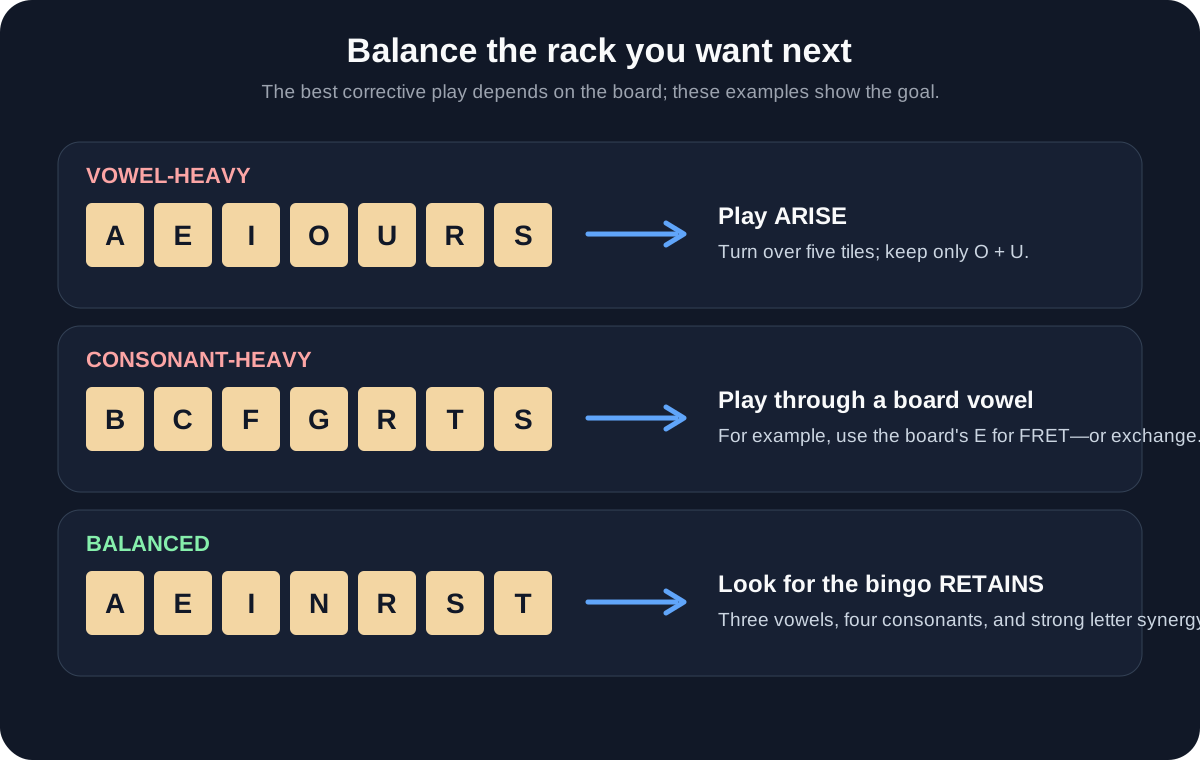
The board still decides what is legal. The point of each corrective play is to improve the next rack, not to prescribe one move in every position.
The word finder makes this repair process visible. Search the complete rack, then compare words by Uses most letters and Score: highest first. Expand Word Breakdown to see the rack’s vowel/consonant ratio. A result that uses three vowels from a vowel-heavy rack may deserve more attention than a higher-scoring result that uses only consonants.
Leave theory: the part of your rack you do not play
Your leave is the group of tiles remaining after your move. If you play PAINT from AEINRST, your leave is ERS. Those three tiles become the foundation of your next seven-tile rack.
Beginners often ask, “What is my biggest score?” Stronger players add a second question: “What do I have to keep?”
Useful leave tiles tend to be common, flexible, and compatible with one another:
E,R,S,T,A, andNcombine well with many draws.- The blank is extraordinarily valuable because it can become any needed letter.
Sis useful for extensions, but two or three of them can become redundant.I,U, andVare harder to combine, especially in pairs or clusters.Qcan become a liability without a compatible vowel or a short escape route.
These are tendencies, not fixed prices. ERST is a strong leave because the letters work together. Four individually useful letters do not automatically make a good leave if they duplicate the same function. Board shape, bag composition, score, and game phase also change the calculation.
Suppose two legal plays score 24 and 20:
| Candidate | Score now | Leave | Strategic reading |
|---|---|---|---|
| Play A | 24 | IUV |
Awkward and vowel-heavy |
| Play B | 20 | ERS |
Flexible, balanced, and bingo-friendly |
Giving up four points for ERS may be an excellent trade. Giving up 18 points probably is not. Rack strategy is not about ignoring score; it is about comparing score with future value.
To study this with the word finder, save realistic candidates to the private Pick List. Add each leave in the note field, then compare the plays side by side. The tool’s Leave Value chart is a directional heuristic, not a board-aware verdict, so use it as a prompt for analysis rather than an automatic move selector.
High-value tile management: do not get stranded with J, Q, X, or Z
Power tiles create big scores when they reach premium squares. They also reduce flexibility when the board tightens. The goal is not to dump every J, Q, X, or Z immediately; it is to keep a reliable exit available.
Memorize short “panic plays” so a premium tile does not sit on your rack for five turns:
| Tile | Short study words | Rack lesson |
|---|---|---|
Q |
QI, QAT |
Know your Q-without-U options; retain an I when it gives the Q an exit. |
Z |
ZA, ZO, ZAX |
A short Z play can score heavily on a letter premium. |
X |
XI, XU, OX, EX |
Keep an eye on two-letter lanes and parallel plays. |
J |
JO, JA, JAB |
Short J words vary by lexicon, so study the list used in your games. |
Dictionary warning: these examples are not universal. MonkeyTactics offers Standard (172,820 ENABLE entries), Expanded (854,775 Wiktionary-derived entries), and Both (867,177 unique entries). Standard remains the default for focused word-game results. The tool is not an official Scrabble dictionary, and club, tournament, app, and regional word lists can differ. Verify unfamiliar words against the authority for your game.
In the word finder, open Advanced Filters and require a high-value tile to isolate escape routes. Search the whole rack first, then use exact length, starts-with, ends-with, or an inline board pattern to model the available lane. This is more useful than memorizing a high-scoring word that never fits.
Bingo stems: turn good racks into 50-point bonuses
A bingo stem is a group of letters that combines with many additions to form seven-letter words. Recognizing stems reduces the search from “What can these seven letters do?” to “What does this one new letter add?”
One of the best beginner stems is SATINE—the six letters A E I N S T. It is balanced, uses common letters, and rearranges readily.
- Add
Rto make bingo candidates such asRETINASandNASTIER. - Add
Dto makeINSTEADandDETAINS.
The strategic lesson is not simply to memorize those four words. It is to notice when a move can preserve AEINST or five letters close to it. A modest play that keeps a productive stem may generate far more bingo chances than a flashy play that leaves mismatched tiles.
Use the word finder as a bingo-stem trainer:
- Enter
SATINE?, where?is a wildcard rack tile. - Choose the dictionary you are studying.
- Set the word length to seven or choose Bingo candidates first.
- Pick an addition, replace the wildcard with that letter, and search again.
- Write down the anagrams you missed before looking at the results.
The wildcard search shows the shape of the stem; the single-letter searches train recall. Remember that a seven-letter result is only a bingo candidate. It must still fit the board and form legal cross-words.
Rack strategy plus board strategy is the real advantage
A beautiful leave has little value if the move gives your opponent a triple-word lane. Rack and board strategy must be evaluated together.
Open the board when your rack is ready
Opening a new lane is more attractive when:
- your leave contains balanced, compatible letters;
- you are preserving a blank or strong bingo stem;
- you are behind and need scoring volatility; or
- the opening is much easier for you to use than for your opponent.
A leave such as AEINST gives you a reason to welcome room. Your next draw may complete a bingo, and an open board provides somewhere to play it.
Close the board when the opponent is ready
Restrict the board when:
- your opponent just made a small play that appears to preserve a strong leave;
- several easy bingo lanes are already open;
- you are ahead and do not need to increase variance; or
- your own rack is clumsy and unlikely to exploit the opening first.
You cannot see the opponent’s rack, so this is inference, not certainty. A small vowel dump, a suspicious two-tile play, or repeated preservation of common stem letters may suggest that a bingo is being prepared.
For every candidate from the word finder, ask three board questions: What lane does it open? What premium square does it expose? Who is more likely to use that space next? The tool narrows the word search; it cannot answer those board questions for you.
When exchanging tiles is the best move
Casual players often treat an exchange as a wasted turn. Sometimes playing for six points and keeping a broken rack wastes more than one turn.
Consider exchanging when you have:
- five or more consonants with no useful board vowel;
- five or more vowels with no efficient vowel dump;
- damaging duplicates such as several
Is orUs; - a
Qwith no practical exit; - almost no scoring play and no leave worth protecting.
Exchange the problem tiles, not automatically the whole rack. If ERST is buried inside a bad rack, keeping that core may be better than throwing all seven tiles back.
Under standard play, an exchange forfeits the turn and is allowed only when enough tiles remain in the bag; check the exact rules being used. Exchanging also loses tempo, so it becomes less attractive when you are far behind, when the bag is nearly empty, or when a reasonable scoring repair is available.
Do not be afraid to score zero—but distinguish an exchange from a pass. An exchange changes the rack and can repair several future turns. A pass changes nothing. Passing is usually reserved for positions where exchanging is unavailable or where a specific endgame tactic makes keeping the rack worthwhile.
How to practice rack strategy with a word finder
Rack judgment improves faster when practice has a decision attached to it. Do not merely count how many words you can find.
Drill 1: big score versus good leave
Enter a random seven-tile rack and find two realistic plays:
- the highest base-score candidate;
- a slightly lower-scoring candidate with the best leave you can identify.
Write down both leaves. Decide how many immediate points you would sacrifice for the better one, then explain why. Save the two words in the Pick List with your reasoning.
Drill 2: repair an unbalanced rack
Start with racks such as AEIOURS, BCFGRTS, and AIIUUVS. Use Word Breakdown to identify the imbalance, then find the move that removes the largest concentration of trouble while retaining compatible letters. If no useful word exists, choose which tiles you would exchange.
Drill 3: build bingo-stem recognition
Choose a six-letter stem such as SATINE, add one random letter, and spend 60 seconds finding bingos without help. Then run the search with Bingo candidates first and record what you missed.
Drill 4: replay an actual rack
After a game, recreate one difficult rack. Add an inline pattern for the board lane if possible, shortlist candidate plays, and compare:
- actual turn score;
- leave quality;
- board opening or closure;
- premium-square exposure; and
- the opponent’s likely reply.
This turns the MonkeyTactics Word Unscrambler & Scrabble Word Finder into a study partner rather than a shortcut. Searches, History, and the Pick List stay in the current browser, making it easy to revisit positions privately.
Rack strategy cheat sheet
Keep this quick reference nearby during post-game study:
| Decision | Fast check |
|---|---|
| Balance | Aim roughly for a 3–4 vowel/consonant split. Repair five-vowel, five-consonant, and more extreme racks. |
| Leave | Favor compatible common letters such as E R S T A N; avoid awkward clusters and unnecessary duplicates. |
| Power tiles | Know short exits for J Q X Z, but verify them in your game’s lexicon. |
| Bingos | Preserve productive stems such as AEINST when the score and board justify it. |
| Board | Open lanes with a strong leave; close them when the opponent appears bingo-ready. |
| Exchange | Exchange when the rack is so damaged that a tiny play will not repair it. Keep any strong core. |
| Word finder | Compare score, leave, turnover, and board risk—never just the longest result. |
Think one rack ahead
Good rack strategy is not about hoarding pretty letters or rejecting every ugly leave. It is the habit of valuing the next turn before it arrives.
Use the 3–4 rule to spot imbalance. Study the tiles left behind. Give power tiles an exit. Preserve bingo stems when the board and score allow it. Exchange when playing would only prolong the damage. Then combine all of that with board control.
A word finder helps because it reveals options you can compare. The winning insight comes from asking the right question about every option: What rack—and what board—does this move give me next?
SCRABBLE and related marks belong to their respective owners. MonkeyTactics is an independent utility and is not affiliated with or endorsed by Hasbro, Mattel, Collins, or Merriam-Webster.